News | Oct 2nd, 2026
Why Sponsorship Sales Often Fail Before the Sales Process Begins

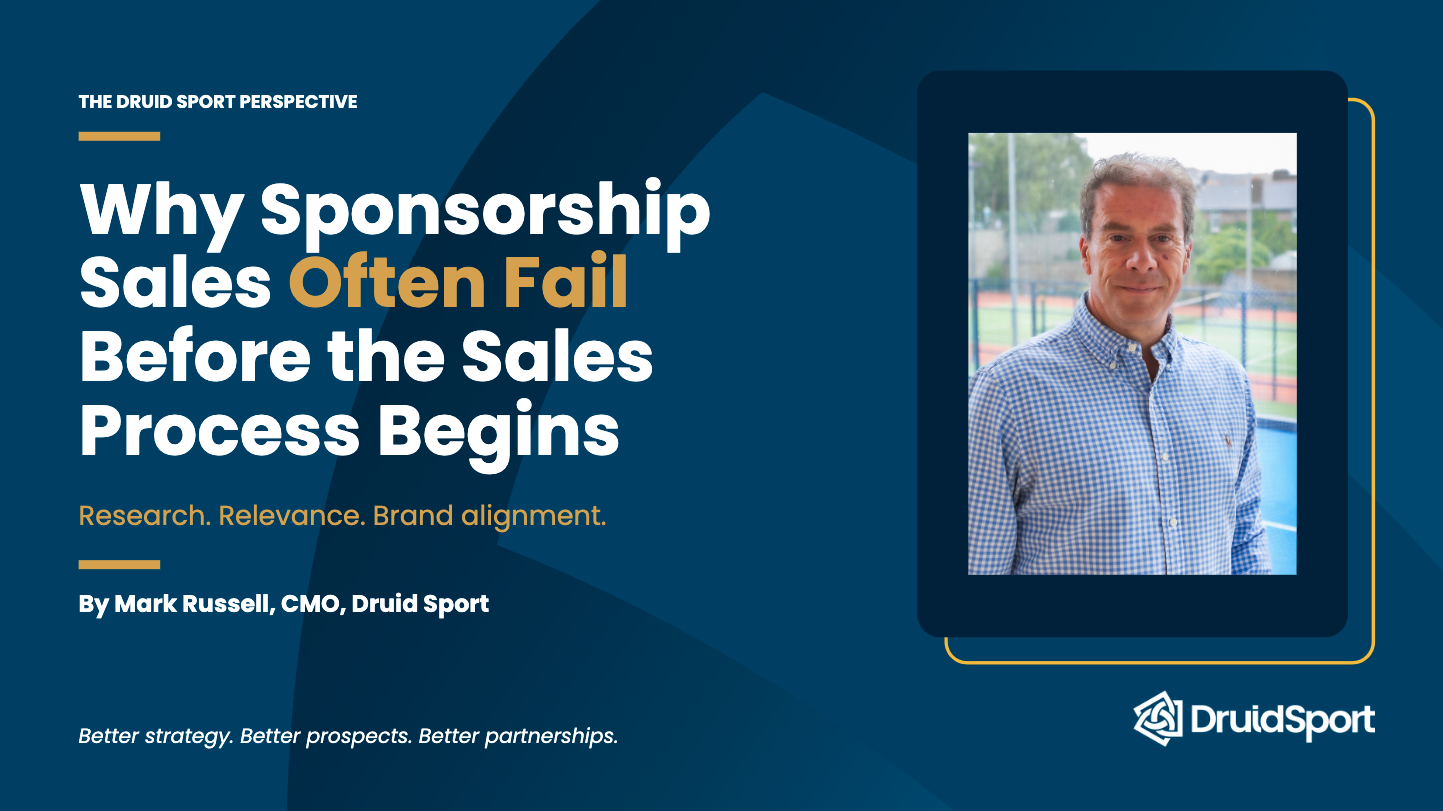
When a sports rightsholder is struggling to attract sponsors, the natural reaction is often to ask the commercial team to generate more leads, send more emails and secure more meetings.
But in my experience, the problem frequently starts much earlier. In fact, I would argue that many sponsorship sales campaigns are already at a disadvantage before the first brand is approached.
Having worked on both sides of the sponsorship relationship, as a sponsorship decision-maker for a major brand and as Commercial Director of a national sporting organisation, I have developed a strong appreciation of what makes a sponsorship opportunity attractive to a potential partner.
And while every rightsholder faces different commercial challenges, I believe there are five common reasons why sponsorship sales campaigns underperform.
1. Starting the Sales Process Without a Clear Commercial Strategy
There is often pressure on rightsholders to generate sponsorship revenue quickly. Understandably, this can lead to sales activity beginning before the commercial proposition has been properly developed.
But having sponsorship rights available to sell is not the same as having a marketable sponsorship proposition.
Before approaching brands, rightsholders need to understand their commercial assets, their audiences, what makes their property distinctive, which sectors offer the greatest potential and how their sponsorship opportunities should be structured and valued.
A clear commercial strategy should establish not just what is being sold, but why a brand would want to buy it and how the rights holder can deliver meaningful value.
Without those foundations, even the most experienced salesperson will struggle.
2. Targeting Brands for the Wrong Reasons
This is an area where I believe sponsorship sales teams can waste an enormous amount of time.
It is relatively easy to compile a list of companies with substantial marketing budgets or a history of investing in sport. But that doesn't necessarily make them suitable sponsorship prospects.
The more important question is whether a rightsholder can genuinely help a brand achieve its marketing and business objectives.
Is the brand entering a new market? Trying to reach a different audience? Building brand consideration? Looking to demonstrate particular values or strengthen relationships with customers and employees?
This is why I place considerable emphasis on brand research and developing a detailed Ideal Partner Profile (IPP) before building a prospect list.
But I also believe there is a simple exercise every sponsorship salesperson should undertake before approaching a prospective brand: do a 180-degree turn and put yourself in the brand's shoes.
If I were the CMO or CEO of this company, what would my business priorities be? What commercial challenges might I be facing? Which audiences or markets would I want to develop? And, crucially, how could this particular sponsorship opportunity help me achieve those ambitions?
The exercise is about anticipating the brand's potential needs, informed by research, before testing those assumptions through meaningful engagement.
The emergence of AI provides a significant opportunity to improve the quality and efficiency of this preparation. AI can help us research a prospective brand's business strategy, marketing priorities, international ambitions, existing sponsorships and potential decision-makers, enabling us to develop a much more informed Ideal Partner Profile. However, the quality of the research, our interpretation of the findings and the commercial judgement we apply remain crucial. AI can help identify potential opportunities and connections, but these must be validated rather than simply assumed.
When we approach a prospective sponsor, our research and understanding of their business should be so compelling that the brand feels almost as though it is the only company that could fit our Ideal Partner Profile.
That isn't about manufacturing a connection or suggesting false exclusivity. It is about demonstrating genuine strategic alignment between the rights holder's proposition and the brand's objectives, values and commercial ambitions.
The objective is not to find as many potential sponsors as possible. It is to identify companies with the strongest reasons to become partners and demonstrate precisely why the opportunity is relevant to them.
3. Selling Sponsorship Assets Rather Than Marketing Solutions
This is perhaps the most fundamental mistake of all.
Too many sponsorship proposals still focus on what a rightsholder has available: branding, signage, digital posts, tickets, hospitality and access to players or athletes.
These are valuable assets, but they are not, in themselves, compelling reasons for a brand to invest.
A successful sponsorship proposition needs to demonstrate how those assets can be brought together to achieve specific marketing objectives.
For one brand, that may be increased awareness and consideration. For another, it could be customer acquisition, product trial, community engagement or building relationships with important business customers.
The October 2026 IPA and Sponsorship Effectiveness Forum research reinforces this point. It identifies clear commercial objectives, effective measurement and integration with wider brand communications as fundamental practices associated with sponsorship effectiveness.
Rightsholders need to think more like marketers and less like sellers of media inventory.
The strongest sponsorship propositions are built around what a partnership can achieve, not simply what assets it includes.
4. Pitching Too Early and Listening Too Little
Securing the attention of senior marketing executives has become increasingly challenging. Brands are frequently approached with sponsorship opportunities, while their marketing teams manage competing priorities and investment decisions.
A generic introductory email followed by an unsolicited sponsorship presentation is rarely an effective way to begin a meaningful commercial relationship.
Good prospect research should inform a relevant initial approach, but the real opportunity comes through discovery.
We need to understand the brand's objectives, decision-making process, budget considerations and timing before attempting to develop a detailed commercial proposal.
We also need to understand the Decision-Making Unit (DMU).
A significant sponsorship investment may involve several stakeholders, each with a different perspective. The CMO may be focused on brand and marketing effectiveness, the CEO on strategic alignment and business growth, and the CFO on investment justification and commercial returns.
Other stakeholders may also influence or approve the decision. Identifying the relevant people, understanding their priorities and recognising who ultimately controls the budget can be just as important as developing the sponsorship proposition itself.
I believe the best sponsorship sales processes are consultative. They are built around asking the right questions, listening carefully and working collaboratively to establish whether there is a genuine opportunity for both parties.
Equally, successful sales campaigns require disciplined follow-up, effective relationship management and patience. Sponsorship decisions can involve numerous stakeholders and lengthy planning cycles.
5. Failing to Demonstrate Commercial Value
Ultimately, sponsorship must compete with other marketing investments.
A brand considering a significant sponsorship commitment needs confidence that the partnership can deliver value and that its contribution can be measured.
Yet this remains a major industry challenge.
Research published by the IPA and Sponsorship Effectiveness Forum in October 2026 found that while 82% of respondents set commercial objectives for sponsorship, only 47% use measurement tools capable of assessing whether those objectives have been achieved.
That is a significant gap.
Rightsholders need to present credible audience data, realistic activation opportunities, an understandable valuation and a clear framework for evaluating the partnership.
Importantly, not every sponsorship should be judged by immediate sales results. Brand awareness, consideration, reputation, customer engagement and other marketing objectives can all represent meaningful value.
The key is to understand what success looks like for the prospective sponsor and demonstrate how the partnership can contribute towards it.
A compelling business case also gives a marketing executive the confidence to champion the opportunity internally.
Better Strategy. Better Prospects. Better Partnerships.
Sponsorship sales will always be challenging. Budgets, timing, competition and changing business priorities mean that even excellent opportunities will not always result in agreements.
But I believe rightsholders can significantly improve their chances by investing more effort in the foundations of their commercial strategy.
That means understanding their own assets and audiences, identifying genuinely relevant brand prospects, putting themselves in the sponsor's shoes, building propositions around marketing objectives and applying a disciplined, consultative sales process.
At Druid Sport, these principles have helped shape our own end-to-end, 10-step sponsorship sales methodology, supported by a five-step outreach framework we call the DRUID Method. Both are built around the importance of research, relevance, brand alignment and developing genuine commercial partnerships.
We are also exploring how AI can strengthen this approach through the development of AI Commercial Director, our proprietary platform designed around an agentic AI architecture. Our ambition is to combine specialist AI capabilities with established commercial methodologies to improve the quality, consistency and efficiency of sponsorship sales. Importantly, we see AI as supporting experienced commercial judgement, not replacing it.
Successful sponsorship sales are not simply about making more approaches. They are about making better approaches, to better-qualified prospects, with more compelling reasons to invest.
And that work starts long before the first sales meeting.